The Core Distinction
Rockfall engineers divide solutions into two philosophies. Active systems intervene at the source, stabilising the slope surface so blocks never detach. Passive systems accept that rocks will fall and are designed to catch or contain them downslope. The choice is not about which is better in the abstract but about where in the rockfall process you can most reliably break the chain. On a fractured face where loose blocks are still attached, an active mesh that pins the surface prevents the problem entirely. On a tall cliff where detachment is inevitable, a passive barrier in the runout zone is the realistic defence. Many corridors use both: active mesh on the upper face plus a passive barrier or catch ditch below. Zhongman manufactures the mesh and net components for both philosophies, supplying highways, railways and mining clients globally.
How Active Systems Work
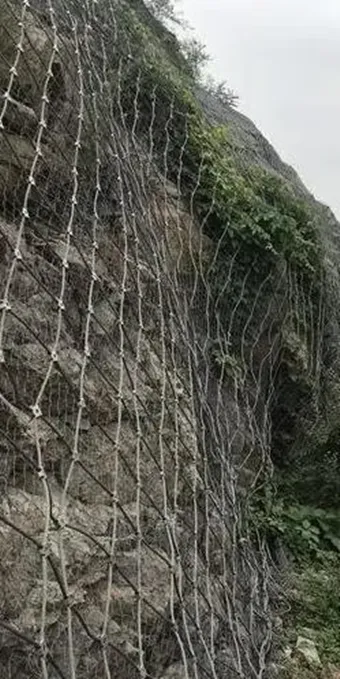
Active protection clamps the slope surface in place. A high-tensile steel wire mesh or cable net is laid across the face and tensioned against a grid of soil nails or rock bolts fitted with spike plates, so the mesh applies pressure that holds loose blocks against the rock mass. Because the mesh is pre-tensioned and fixed at intervals rather than merely draped, debris cannot accumulate or bulge behind it. These systems suit highly fractured but relatively shallow instability, where individual blocks are small to medium and the geometry allows anchors to reach competent rock. The design balances mesh strength, anchor pattern and pre-tension. Zhongman produces high-tensile diamond mesh, double-twist mesh and cable net panels in the wire diameters and mesh sizes that geotechnical designers specify for surface stabilisation, all hot-dip galvanized or Galfan coated for long service.
How Passive Systems Work
Passive protection lets the rock fall and stops it before it reaches what you are protecting. The principal passive structure is the dynamic barrier, a flexible net on posts and anchored cables rated for a specific kinetic energy, with brake elements that absorb the impact by yielding under load. Other passive measures include catch fences, simple draped netting that guides debris to a toe ditch, rock sheds and embankments. The defining feature is location: passive systems sit in the runout path, not on the source. They are essential where the source is inaccessible, too tall to anchor economically, or where blocks are large enough that prevention is impractical. Zhongman supplies the interception mesh, ring nets and cable nets used in catch fences and dynamic barriers, manufactured from high-tensile galvanized wire to match the required energy class.
Choosing Between Them
The decision flows from the geotechnical investigation. Map the source zones, estimate block sizes and trajectories, and calculate the design impact energy. If the unstable face is accessible and blocks are modest, an active mesh that prevents detachment is often the most durable and lowest-maintenance answer. If detachment is unavoidable or energies are high, a passive barrier sized to the design energy is required, with its rating set safely above the calculated value. Budget, access for installation and maintenance, and the consequences of failure all weigh in. Frequently the most robust scheme is hybrid. Coating choice applies to both: Galfan zinc-aluminium for aggressive or coastal slopes, hot-dip galvanizing as the baseline elsewhere. Zhongman's engineering team can advise on which components fit your analysis and supply samples for verification before you finalise the design.
Specifying and Sourcing
Whichever philosophy your design adopts, a clear specification protects the project: name the system type, mesh or net with wire diameter and aperture, energy class for passive barriers, anchor pattern for active systems, coating with documented mass, and the governing standard. For export projects, insist on container-ready packing and traceable certificates so components match the drawings on arrival. Zhongman manufactures the full range of high-tensile mesh, double-twist mesh, cable nets and ring nets for both active and passive rockfall protection, with certified galvanizing and Galfan coatings, packed for safe international shipping. If you need component drawings, energy-class confirmation, samples or a costed bill of materials for an upcoming tender, send us your slope data and we will return a compliant, competitive proposal.