What a Load Table Tells You
A bar grating load table is the single most important tool for specifying steel grating safely. It maps the relationship between bearing bar size, clear span and the load the panel can carry, while keeping deflection within acceptable limits. Each table is built for a specific bearing bar spacing and material, and lists allowable uniform loads (in kPa or psf) and concentrated loads (a point load at midspan) for a range of spans. The numbers already account for the grating's section properties, so you do not have to calculate stress yourself. Your job is to match the table to your actual span and required load, then read off a bearing bar that satisfies both strength and deflection. Misreading a load table is a common and dangerous source of under-specified platforms.
Span, Bearing Bar and Spacing
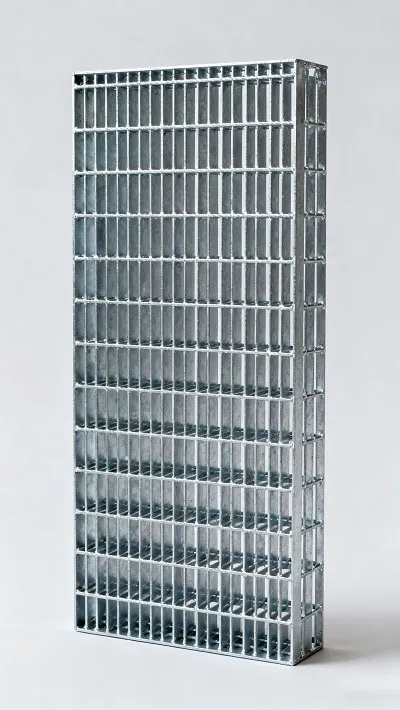
Three variables dominate grating capacity. Span is the clear distance between supports; capacity drops sharply as span increases, often with the cube of the length for deflection. Bearing bars are the load-carrying flat bars running in the span direction; their height (depth) is the biggest lever for strength, so a 40 mm bar far outperforms a 25 mm bar of the same thickness. Bearing bar spacing, commonly 30 mm or 40 mm centers, sets how many bars share the load and how small an object can pass through. Cross bars, set perpendicular and typically at 50 mm or 100 mm pitch, tie the panel together and distribute concentrated loads. When you read a table, confirm all three match your panel, because a value for 40 mm centers does not apply to a 60 mm spacing panel.
Uniform vs Concentrated Loads
Load tables list two load cases because real platforms see both. Uniform load is a pressure spread evenly across the panel, suitable for crowd loading, stored material or general access floors. Concentrated load is a single heavy point, such as a wheel, a jack or a foot, applied at the worst-case position, usually midspan; this case often governs for narrow panels or maintenance walkways. Always check your application against both columns and design to whichever is more demanding. Deflection limits matter too: many specifications cap deflection at span over 200 or to a fixed millimeter value for comfort and to protect adjacent finishes. A panel can be strong enough yet feel bouncy if deflection is ignored, so treat the deflection-controlled value as a real limit, not a footnote.
Materials, Coatings and Standards
Most bar grating is carbon steel, hot-dip galvanized after fabrication to ASTM A123 or EN ISO 1461 so every bar, weld and edge is protected. For corrosive or hygienic settings, stainless steel grating is used; for lightweight or non-magnetic needs, aluminum is available. Coating does not change the structural load table, but it determines service life, so specify galvanizing mass appropriate to the environment, and consider Galfan or additional coatings for severe exposure. Load values themselves follow recognized references such as the NAAMM and ANSI grating standards in North America and equivalent EN guidance in Europe. When buying internationally, confirm which standard the supplier's tables are based on so your safety factor and deflection assumptions are consistent with local codes.
Safety Factors and Common Mistakes
Published load tables already include a safety factor, but specifiers still make avoidable errors. The most frequent is reading a value for the wrong bearing bar spacing or cross bar pitch, which can overstate capacity significantly. Another is checking only the uniform load when a concentrated wheel or jack load actually governs. A third is ignoring the deflection-controlled value and selecting a bar that is strong enough but feels unacceptably springy underfoot. Edge support conditions matter too: a panel assumed to be simply supported at both ends behaves very differently if one edge is unsupported at an opening. When in doubt, step up one bearing bar size or shorten the span with an intermediate support. A small increase in bar depth cheaply buys a large margin in both strength and stiffness.
Specifying Grating with Confidence
To select grating, start with your clear span and design load, choose the load case that governs, then pick the smallest bearing bar that satisfies both strength and deflection from the correct table. Add the panel size, bearing bar spacing, surface (serrated or plain), edge banding and coating to complete the spec. For export, state your destination so packing and freight can be planned. As a Hebei manufacturer and exporter, Zhongman supplies welded, swage-locked and press-locked steel grating in carbon steel, stainless and aluminum, hot-dip galvanized to ASTM or EN, fully customizable to your load and span. Send us your span, required load and panel layout, and our engineers will recommend a compliant bearing bar and prepare a tailored quotation.