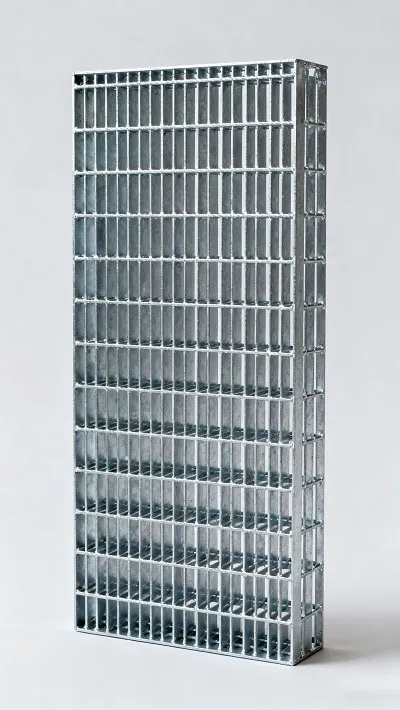
Three Products, Three Manufacturing Methods
Expanded metal, perforated metal and welded mesh are often confused, but they start from completely different processes. Expanded metal is made by slitting and stretching a single sheet, so there is no waste and the strands are integral to the base material. Perforated metal is produced by punching holes out of a solid sheet, removing material to create the open pattern. Welded wire mesh is built up from individual steel wires laid in a grid and resistance-welded at each intersection. Each method produces a distinct combination of strength, open area, weight and look. Understanding how the product is born is the fastest way to predict how it will behave in service, which is why buyers should match the manufacturing method to the application rather than choosing on appearance alone.
Strength, Weight and Open Area
Because expanded metal is stretched from a solid sheet, it is exceptionally strong for its weight and has no welds to fail, making it ideal for walkways, security screens and machine guards. Perforated metal retains the rigidity of a continuous sheet but loses strength in proportion to its open area; it is the most refined-looking of the three and is favored for facades and acoustic panels. Welded mesh offers very high open area with a clean grid, excellent for fencing, cages, partitions and concrete reinforcement, but its strength depends on weld integrity at each node. As a rough guide, expanded metal gives the best strength-to-weight ratio, perforated gives the best aesthetics, and welded mesh gives the most open area and the lowest cost per square meter for fencing-grade applications.
Typical Applications by Product
Each product has natural homes. Expanded metal suits anti-slip platforms, stair treads, fences, sieves, sunscreens and reinforcement of render and plaster. Perforated metal dominates architectural cladding, filtration, sound attenuation, signage and decorative panels where a precise pattern is required. Welded mesh is the default for security and boundary fencing, animal enclosures, gabion baskets, shelving, and reinforcing mesh in slabs and walls. There is overlap; for example, both expanded and welded products are used for fencing, but expanded resists cutting and climbing better while welded mesh is lighter and cheaper. Knowing the dominant use cases helps a buyer shortlist quickly before fine-tuning dimensions and coating. Zhongman manufactures all three product families, so we can advise objectively rather than pushing a single line.
Cost, Maintenance and Lifespan
Cost ranks roughly from welded mesh as the most economical for fencing volumes, through expanded metal, to perforated metal which carries higher tooling and material-removal costs. However, the cheapest sheet is not always the lowest lifetime cost. Maintenance and lifespan hinge on coating: a hot-dip galvanized or Galfan zinc-aluminum finish, optionally topped with PVC or powder coat, transforms service life in outdoor and coastal settings. Expanded and perforated sheets coated after fabrication seal cut edges well; welded mesh should ideally be welded first then galvanized so weld points are protected. When comparing quotes, look beyond price per kilogram to coating mass, expected environment and replacement interval. A correctly specified, well-coated panel can outlast a thinner, cheaper alternative two or three times over.
Coatings That Apply Across All Three
Whichever product you select, coating determines how long it survives outdoors. Carbon steel versions of expanded metal, perforated sheet and welded mesh are commonly hot-dip galvanized for a robust zinc barrier, or finished with a Galfan zinc-aluminum alloy that offers superior corrosion resistance and self-healing at scratches. A PVC or polyester powder topcoat then adds color and a second protective layer, which is popular for fencing and architectural panels. Stainless steel needs no extra coating and suits hygienic or marine use, while aluminum can be anodized or PVDF-coated. The key principle is to coat after fabrication wherever possible so cut edges and weld points are sealed, and to match coating mass to the aggressiveness of the environment rather than defaulting to a single standard for every project.
How to Choose and Where to Buy
Start with the function: do you need strength, appearance, or maximum open area at low cost? Then layer on environment, load, and any standard you must meet, such as ASTM or EN. Provide your supplier with material grade, dimensions, hole or mesh size, strand or wire diameter, sheet size and coating, plus the destination for export pricing. As a Hebei manufacturer and exporter, Zhongman produces expanded metal, perforated metal, welded mesh, woven mesh, gratings and fencing under one roof, all customizable and supplied with export-grade packing and ASTM or EN compliance. If you are unsure which product fits, send us your application and we will recommend the most cost-effective option and prepare a tailored quotation for your project.