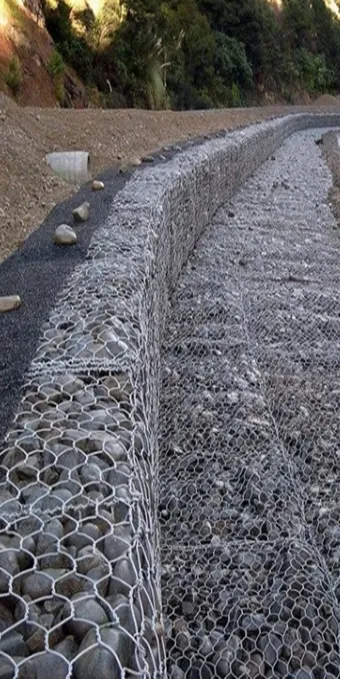
Why Installation Decides Performance
A gabion structure is only as good as the way it is built. The baskets and wire can be perfectly specified, but poor assembly, weak lacing, careless filling or a neglected foundation will see a wall bulge, settle or wash out long before its design life. Most gabion failures are installation failures, not material failures. The good news is that the mistakes are well known and entirely avoidable with care and the right consumables. For buyers and contractors, understanding these pitfalls before mobilising on site is the cheapest insurance available, and it lets you check that whoever supplies your baskets also supplies the lacing wire, C-rings and guidance you need to build them correctly.
Skipping the Foundation and Filter
The most damaging mistakes happen below the visible structure. Founding a gabion wall too shallow, above the expected scour depth, invites the water to undercut the toe and pull the whole wall down. Equally common is omitting the filter layer: without a geotextile or graded granular filter between the bank and the baskets, fine soil washes out through the rock voids, the bank loses material and the wall settles into the cavity. Every gabion retaining or erosion structure needs a toe founded below scour and a filter on the soil face. We can supply geotextile alongside the baskets, but the contractor must place it correctly and key the toe in deep enough for the hydraulic conditions.
Weak Lacing and Connections
Gabions only work as a structure when individual baskets are joined into a single monolithic mass. A frequent error is under-lacing: too few stitches, skipped seams or using the wrong wire, so units act independently and the wall pulls apart under load. Every adjoining edge, every lid and every internal diaphragm must be laced continuously, alternating single and double loops at the spacing the standard requires, or joined with the correct number of properly closed C-rings. Hand-twisting lacing wire too loosely, or using galvanized wire that does not match the basket coating, undermines both strength and corrosion life. We supply matched lacing wire and pneumatic C-rings and advise on stitch spacing so connections are as strong as the panels they join.
Bad Filling Practice
Filling looks simple but causes more visible problems than anything else. Dumping rock straight from a bucket creates voids, segregates the stone and bulges the front face. Good practice is to hand-pack the visible faces with selected angular rock, fill in 250 to 300 mm layers, and place internal connecting wires between layers in taller baskets to tie the front and back faces together and stop them spreading. Using fill that is too small lets stone migrate through or out of the mesh; too large leaves big voids that settle later. Over-filling distorts lids so they will not close. Patient, layered, hand-finished filling is the difference between a crisp wall and a bulging one.
Wrong Material for the Environment
A subtler mistake is specifying the right basket but the wrong protection for the site. Plain galvanized mesh in permanent salt water, or light wire on a high-velocity channel, will corrode or abrade prematurely no matter how well it is built. Mixing coatings, such as PVC-coated baskets laced with bare galvanized wire, creates galvanic weak points at every joint. The fix is to match coating and gauge to the exposure across the whole structure including consumables: Galfan or PVC for aggressive and submerged sites, heavier wire for fast water and impact, and lacing wire of the same coating family as the baskets. Specifying this correctly at order stage prevents an expensive premature failure later.
Build it Right with the Right Supplier
Zhongman manufactures woven and welded gabions, Reno mattresses and the matched lacing wire, C-rings and geotextile that proper installation requires, all from our Hebei works with in-house galvanizing, Galfan and PVC coating. We produce to ASTM A975 and EN 10223 and can provide brief installation notes covering founding depth, filter placement, lacing and layered filling so your crew avoids the common errors. Ordering baskets and consumables together as a matched, correctly coated package is the simplest way to ensure a structure that lasts. Tell us your wall height, site conditions and quantities and we will return a complete specification, consumable list and export quotation for your review.