Why Mesh Size and Gauge Matter
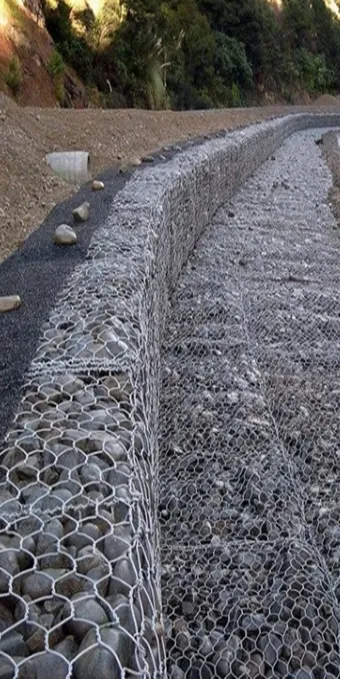
Two numbers define a gabion mesh: the aperture, which is the size of each opening, and the wire gauge or diameter that forms it. Get them wrong and a basket either lets its fill escape or costs more than the job needs. Aperture must be smaller than the smallest fill stone so nothing washes or falls out, while wire diameter must be heavy enough to carry the rock load and resist abrasion, corrosion and impact over the design life. Selvedge wire on the edges, lacing wire at the joints and the mesh type itself all interact with these choices. Understanding how they fit together lets a buyer specify a basket that performs without over-paying for steel that the application does not require.
Standard Mesh Apertures
Woven double-twisted hexagonal gabions come in a handful of standard apertures, expressed as the twist dimension by the mesh width. The common sizes are 60x80, 80x100 and 100x120 mm. 60x80 suits smaller fill and finer structures, 80x100 is the general-purpose retaining-wall size, and 100x120 takes larger rock for big structural baskets and mattresses. Welded gabions instead use square or rectangular openings, typically 50x50, 75x75, 100x50 or 100x100 mm, chosen for a crisp architectural face. The rule across both families is the same: aperture must be at least slightly smaller than the smallest fill dimension, and most engineers size fill at 1.5 to 2 times the aperture for a safe margin against migration.
Wire Gauges and What They Carry
Wire diameter is the strength variable. For woven hexagonal gabions, mesh wire runs from 2.0 to 3.0 mm, with 2.7 mm a common retaining-wall choice and 3.0 mm for heavy structural and erosion work. Selvedge wire, which binds the panel edges, is always one step heavier, typically 3.4 to 3.9 mm, because edges concentrate stress. Lacing or binding wire is around 2.2 mm. Welded gabions use thicker wire, 3.0 to 5.0 mm, to achieve their rigid flat faces. Heavier gauge means more corrosion allowance and impact resistance but also more weight and cost. We help buyers pick the gauge that matches the wall height, water velocity and exposure rather than defaulting to the heaviest or cheapest option.
Coating Adds to the Diameter
Quoted wire diameter normally refers to the core steel before coating, so the finished wire is slightly larger. This matters because corrosion protection is part of the gauge decision. Heavily galvanized wire (Class 3 zinc, up to 275 g per square metre) is the baseline. Our Galfan zinc-aluminium coating offers two to three times the life of pure zinc for harsh or submerged service. PVC coating over a galvanized core adds a polymer skin, perhaps 0.5 mm thick, raising the nominal diameter and giving the longest protection in saline or polluted conditions. When comparing prices, buyers should confirm whether a diameter is core or coated, and which coating standard applies, so quotes are compared on a true like-for-like basis.
Matching Mesh to the Application
Pulling it together: a low decorative garden wall might use welded 75x75 mm mesh in 4.0 mm galvanized wire with 60 to 100 mm fill. A river retaining wall could use woven 80x100 mm mesh in 2.7 mm Galfan wire with 3.4 mm selvedge and 120 to 200 mm rock. A scour mattress would use 60x80 mm mesh in finer wire with small fill. Higher water velocity, taller walls, ice and debris all push you toward heavier gauge and double-twist or welded construction; benign, dry, decorative sites allow lighter, cheaper specifications. The right answer is always the combination of aperture, gauge, coating and mesh type that meets the loading at least cost, not a single universal product.
Get the Right Spec from China
Zhongman manufactures woven hexagonal and welded gabions across the full range of standard apertures and wire gauges from our Hebei works, with in-house wire drawing, galvanizing, Galfan and PVC coating. We produce to ASTM A975 and EN 10223 and certify core diameter, coating mass, mesh dimensions and tensile properties so your engineer can verify every number. We can also cut and assemble baskets to non-standard sizes for special projects. If you are unsure which aperture, gauge or coating fits your wall height, fill and exposure, send us those details and we will recommend a complete specification and return an export quotation for your review.