Why Two Standards Exist
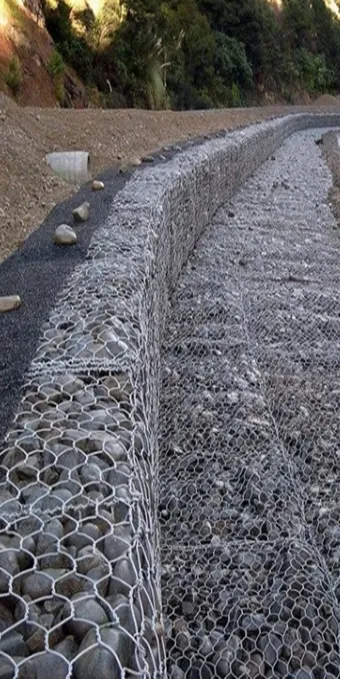
Gabions are deceptively simple, just wire baskets filled with stone, but their performance over decades depends on details that two major standards exist to control. ASTM A975 is the American specification for double-twisted hexagonal gabions and revet mattresses, widely referenced across the Americas, the Middle East and many international tenders. EN 10223-3 is the European standard for hexagonal steel wire mesh products for civil engineering, governing gabions across Europe and the markets that follow CE practice. Both fix the same critical variables, wire diameter, mesh dimensions, tensile strength and coating mass, but with different test methods, tolerances and numerical limits. Knowing which standard your project follows matters, because a basket that meets one may not meet the other. Zhongman manufactures gabions to both ASTM A975 and EN 10223-3, so clients can specify whichever their market or funder requires and receive documented compliance.
Wire Diameter and Mesh Size
Both standards build the gabion from double-twisted hexagonal mesh and define the mesh by a type designation such as 8 x 10 or 6 x 8, where the numbers relate to the twist dimensions. Common mesh wire diameters run from about 2.0 mm to 3.0 mm for the netting, with thicker selvedge wire of around 2.4 to 3.9 mm reinforcing the edges and thinner lacing wire for assembly. The standards set permitted diameter tolerances and the dimensional limits for mesh opening, which together govern how much stone the basket retains and how it deforms under load. EN 10223-3 and ASTM A975 use comparable mesh families but state their tolerances differently, so a careful specifier names the mesh type and wire diameters explicitly rather than relying on a generic label. Zhongman supplies the full range of mesh types and wire diameters under either standard, woven to the stated tolerances.
Tensile Strength and Wire Grade
The wire itself must be strong and ductile enough to twist without cracking and to hold its shape when filled and loaded. Both standards specify the tensile strength range of the base steel wire, typically in the order of 350 to 550 MPa for soft-temper gabion wire, along with elongation requirements that ensure the wire bends rather than snaps. The double-twist construction is mandated precisely because, unlike welded or single-twist mesh, it does not unravel if a wire is cut or corrodes, which is a core safety property both standards protect. Test methods for tensile and elongation differ in detail between ASTM and EN, so certificates should state which method was used. Zhongman tests wire to the relevant standard and issues tensile and elongation certificates with each batch, so an engineer can confirm the steel grade rather than infer it from appearance.
Coating Requirements: The Real Differentiator
Coating is where the standards bite hardest, because it sets service life. Both define minimum coating masses for zinc and for Galfan zinc-aluminium alloy, expressed in grams per square metre and rising with wire diameter. Galfan, the Zn-5%Al-mischmetal coating, is recognised by both as a higher-durability option offering roughly two to four times the corrosion resistance of pure zinc, and it is increasingly the default for demanding environments. Where a PVC overcoat is used for severe abrasion or chemical exposure, the standards specify the polymer thickness over the metallic coating. The minimum coating mass is the single most common place specifications are quietly undercut, so it must be stated and verified against the standard's table for the chosen wire diameter. Zhongman applies certified zinc, Galfan and PVC coatings meeting the mass limits of both ASTM A975 and EN 10223-3, with coating test reports supplied per shipment.
Specifying and Sourcing to Standard
To procure compliant gabions, state the standard (ASTM A975 or EN 10223-3), the basket and diaphragm dimensions, the mesh type with mesh and selvedge wire diameters, the coating system with minimum mass for that diameter, and the lacing or fastening method. Requiring mill and coating certificates against the named standard prevents substitution of thin wire or light zinc. For export, gabions ship flat-packed, bundled and strapped, with assembly instructions, and documentation should travel with the goods. Zhongman manufactures gabions to both ASTM A975 and EN 10223-3, custom dimensions included, with full tensile and coating certification, packed for global container shipping. If you are writing a gabion specification and want to be sure your tender language is watertight, or you need certified samples for approval, send us your requirements and our engineers will confirm compliance and return a costed quotation.