Designing a Gravity Structure
A gabion wall is a gravity retaining structure: it resists soil pressure through its own mass rather than through reinforcement or anchoring. That makes three design elements decisive, the batter, or backward lean of the face, the drainage system, and the foundation. Get these right and a gabion wall is remarkably stable and forgiving; get them wrong and it can slide, overturn, bulge or settle. Good design also considers the wall's cross-section, stepping and the interaction between the structure and the retained soil. This article covers the core principles so engineers, contractors and serious self-builders can specify a wall that performs, rather than relying on rough rules of thumb alone.
Batter: The Angle That Adds Stability
Batter is the backward inclination of the wall face toward the retained soil, and it significantly improves stability by directing the mass and the resultant force into the slope. Gabion gravity walls are commonly built with a batter of about 6 to 10 degrees, achieved either by stepping back successive courses or by tilting the whole face. A battered wall resists overturning far better than a vertical one of the same size, often allowing a thinner, more economical cross-section. Stepped designs can place steps on the front face for a terraced look or on the back to keep a clean front. The correct batter depends on wall height, soil and load, so it should follow from analysis. As a rule, the taller the wall and the weaker the soil, the more batter or base width you need to keep the resultant force safely within the structure.
Drainage and Filter Layers
One of the gabion wall's great advantages is its free-draining nature, but the retained soil behind it still needs management. Place a granular drainage layer or a geotextile filter between the gabions and the backfill to allow water through while preventing fine soil particles from washing into the structure, a process that would clog drainage and undermine the fill. Without a filter, fines migrate, voids form and settlement follows. The geotextile also separates dissimilar materials and adds long-term stability. Even though gabions relieve hydrostatic pressure better than concrete, neglecting the filter layer is a common and damaging mistake, so it should be a standard part of every retaining design.
Foundations and Bearing
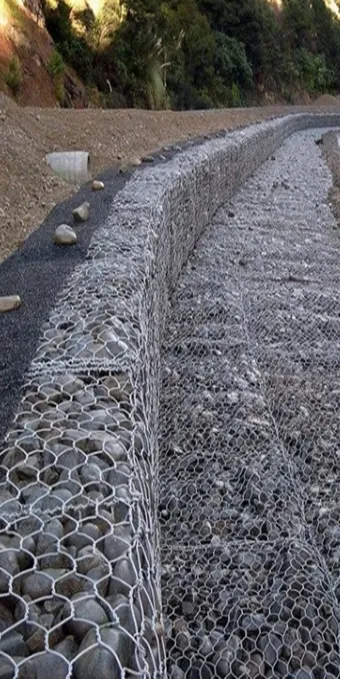
Because a gabion wall concentrates significant weight, the foundation must carry it without excessive or differential settlement. Excavate to firm ground and provide a level, compacted granular base course wide enough to support the wall and its batter. On weak soils, widen the base, add a foundation gabion course, or use geotextile reinforcement to spread loads. The flexibility of gabions tolerates modest settlement better than rigid walls, but the base must still be sound. Embedment below grade at the toe helps resist sliding and protects against scour where water is present. A properly sized, compacted and, where needed, scour-protected foundation is the platform on which the whole design depends. Where a river or channel runs at the base, extending a Reno mattress in front of the toe is a reliable way to stop undermining before it starts.
Stability Checks and Detailing
A complete gabion design verifies the standard gravity-wall failure modes: sliding along the base, overturning about the toe, bearing capacity of the foundation soil, and overall slope stability through the wall and ground. Taller walls may need a wider base, increased batter or stepped sections to satisfy these checks. Detailing matters too: lace baskets and courses together so the wall acts as one mass, brace internally against bulging, and protect the toe against scour in hydraulic settings. Follow recognized standards and, for significant walls, have a qualified engineer perform the analysis. Sound stability checks plus careful detailing turn a stack of baskets into a reliable, long-lived structure.
Design Support and Supply from Zhongman
Good design needs baskets specified to match. Zhongman manufactures and exports gabion baskets, welded and woven double-twisted mesh, Reno mattresses and slope-protection systems from Hebei, China, in galvanized, Galfan (Zn-Al) and PVC coatings, with customizable wire diameter, mesh aperture and dimensions to ASTM and EN standards. We supply lacing and bracing wire and geotextile filter options, all packed for efficient container export. Share your wall height, soil conditions, water exposure and target standard, and our team will help you specify baskets to suit your batter, drainage and foundation design and provide a quotation. Contact Zhongman to request specifications or a sample for your project.