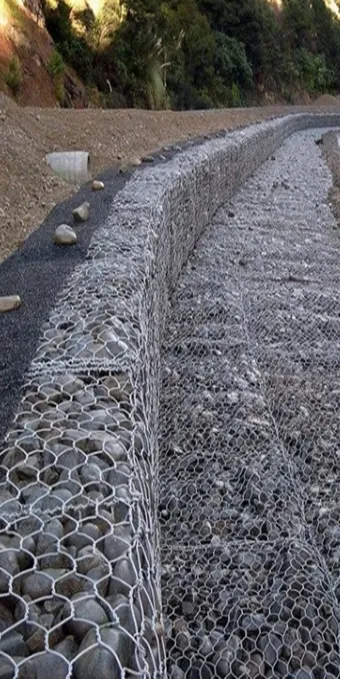
Two Materials, One Job
Gabions and geotextiles are often specified separately, but in most retaining and erosion structures they are a team that fails when split up. A gabion basket filled with stone is strong, heavy and free-draining, which is exactly why water moves through it readily. That permeability is a strength for relieving pressure but a weakness for the soil behind, because flowing water can wash fine particles out through the stone, hollowing the backfill and eventually undermining the structure. A geotextile placed between the gabion and the retained soil acts as a filter: it lets water pass while holding the fines in place. The result is a structure that drains freely yet stays full and stable. Zhongman supplies gabion baskets engineered to work with a geotextile filter layer, and advises clients to specify both so the system performs as intended.
How the Filter Works
A geotextile filter performs two simultaneous tasks: separation and filtration. Separation keeps the stone fill of the gabion from punching into and mixing with the finer retained soil, preserving the gradation of each. Filtration lets pore water escape through the fabric while retaining soil particles, preventing the piping erosion that quietly destroys drainage structures. The fabric must be matched to the soil it filters; its apparent opening size has to be small enough to retain the fines yet open enough to keep flowing without clogging. Non-woven needle-punched geotextiles are common behind gabions because their thickness and pore structure suit filtration, while woven fabrics serve where separation and strength dominate. Getting the opening size and permeability right for the specific soil is a design decision. Zhongman can advise on pairing the right filter class with the gabion facing for your ground conditions.
Where the Pairing Matters Most
The gabion-plus-geotextile combination earns its keep wherever water and fine soils meet a gabion face. Riverbank and channel protection is the classic case: current and fluctuating water levels would otherwise leach fines straight through the basket, so a filter is essential. Retaining walls on cohesive or silty backfill rely on the geotextile to stop the fines that would clog the drainage path or wash away. Coastal revetments, culvert outfalls, bridge abutments and reinforced slopes all benefit. The only situations where a filter may be omitted are clean, free-draining granular backfills that contain no migratable fines, and even then many engineers include a fabric as cheap insurance. Zhongman has supplied gabions for riverbank, coastal and retaining applications around the world, and recommends the geotextile filter as standard practice rather than an optional extra.
Coatings, Standards and Compatibility
The geotextile protects the soil, but the gabion's own durability still rests on its coating. Hot-dip galvanizing is the baseline; for riverine, coastal or polluted environments, where the filter pairing is most needed, Galfan zinc-aluminium or a PVC overcoat greatly extends the basket's life in wet, salty conditions. Gabion wire, mesh and coating should conform to ASTM A975 or EN 10223-3, which set wire diameter, mesh size, tensile strength and minimum coating mass. The geotextile should carry its own documented properties: opening size, permeability, tensile and puncture strength. Specifying both standards ensures the two materials are genuinely compatible rather than nominally present. Zhongman manufactures gabions to ASTM A975 and EN 10223-3 with certified galvanizing, Galfan and PVC coatings, and provides the documentation an engineer needs to confirm the structure will drain, filter and last.
Specifying and Sourcing Both Together
A complete specification treats the gabion and geotextile as one system: name the basket size, wire diameter, mesh and coating to ASTM A975 or EN 10223-3, and the geotextile type, opening size, permeability and strength matched to the retained soil, with installation detail showing the fabric continuous behind and beneath the baskets. For export projects, coordinate packing so both arrive together and undamaged. Zhongman exports gabion systems globally and can advise on the compatible geotextile filter class for your soil, supplying flat-packed baskets, lacing wire and full certificates packed for container shipping. If you are designing riverbank, retaining or coastal protection and want a gabion facing that drains without eroding, send us your soil data and structure geometry and our team will recommend a matched gabion-and-filter solution with a costed quotation.