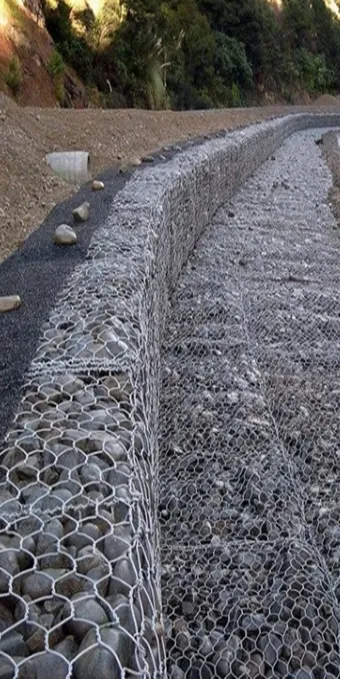
Plan and Prepare the Site
A successful gabion wall starts long before the first basket is filled. Begin by confirming wall height, total length and the design batter (backward lean), which is typically 6 to 10 degrees for gravity gabion walls. Check soil bearing capacity and groundwater, and obtain any required permits. Calculate how many baskets you need based on standard sizes, commonly 2 x 1 x 1 m or 1 x 1 x 1 m units, and order matching mesh, lacing wire and bracing wire. Estimate fill stone volume, allowing for roughly 30 to 40 percent void space. Good planning also means choosing the right coating, galvanized, Galfan or PVC, for your climate before materials arrive on site. Sketch the wall cross-section, mark where stepped courses fall, and confirm access for delivery trucks and any filling equipment so the build runs smoothly once materials land.
Excavate and Build the Foundation
Mark the wall line and excavate a level trench for the base course. The foundation must be firm, level and well-compacted; soft spots will cause uneven settlement. For most walls, place and compact a granular base of crushed stone to provide bearing and drainage. On weak soils, a wider footing course or a geotextile separation layer helps spread loads and prevent fines from migrating into the structure. The base should be wide enough to support the planned batter and any stepped courses behind it. Getting this stage right is critical, because a gabion wall is a gravity structure and depends entirely on a stable, level foundation to perform as designed.
Assemble and Position the Baskets
Unfold each flat-packed gabion basket and lift the sides, ends and diaphragm panels into the upright box position. Join adjacent panels along their edges with lacing wire or interlocking spiral binders, stitching every mesh opening or in the alternating single-double pattern recommended by your supplier. Connect neighboring baskets to one another so the completed course acts as one continuous unit. Position the assembled empty baskets along the prepared foundation, set the correct batter, and check alignment with a string line. Secure them temporarily before filling. Taking time to fully lace and connect empty baskets is far easier than trying to correct gaps once they are loaded with stone. A continuous, properly stitched course distributes load evenly and is the foundation of a wall that behaves as one coherent gravity mass.
Fill with Stone and Brace
Fill baskets with angular, durable rock sized larger than the mesh aperture, usually 100 to 200 mm, so stones cannot escape. Hand-pack the visible outer faces tightly for a clean appearance and place machine fill in the interior, keeping voids to a minimum. Fill in lifts of about 300 mm and install internal bracing wires between opposing faces to prevent bulging as load increases. Level each basket slightly proud of the top before closing, since stone settles. Even, well-packed filling is what gives the wall its strength and prevents the deformation that ruins poorly built gabion structures, so do not rush this stage or over-fill in a single lift.
Close, Stack and Finish
Once a basket is filled and bulge-free, fold the lid down and lace it securely to all top edges. Build successive courses by setting baskets on top, maintaining the batter and offsetting or aligning joints per your design, and lace each new course to the one below. Backfill behind the wall with free-draining granular material and compact in layers; add a geotextile or filter layer where fines could wash through. Finish the top course neatly and, if desired, plant the structure or add soil pockets for vegetation. Inspect all lacing before completion. A carefully laced, well-drained wall built on a sound base will perform reliably for decades.
Get the Right Baskets and Wire from Zhongman
Building a durable gabion wall depends on quality mesh, strong lacing wire and the right coating for your site. Zhongman is a Hebei, China manufacturer and exporter of woven (double-twisted) and welded gabion baskets, Reno mattresses, lacing and bracing wire, and full slope-protection systems. We offer galvanized, Galfan (Zn-Al) and PVC coatings, customize basket dimensions, mesh size and wire diameter, and supply to ASTM and EN standards with secure container packing for export. Send us your wall dimensions and site conditions and we will recommend a basket specification and quote. Contact Zhongman to request a spec sheet or sample before your next build.