What a Sack Gabion Is
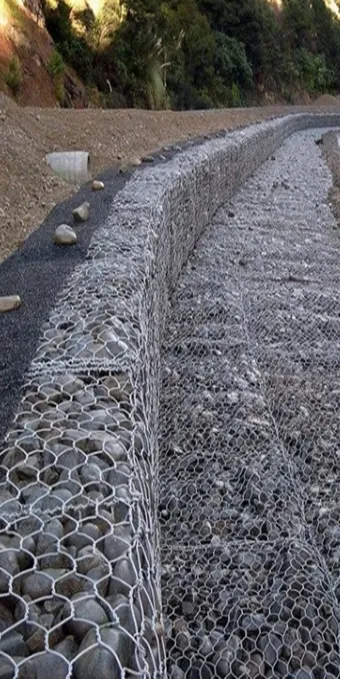
A sack gabion is a long cylindrical or sausage-shaped tube of hexagonal woven wire mesh, closed at the ends and laced along its length. Unlike rigid box gabions, a sack is filled with rock and then lifted and placed as a single flexible unit, often by crane or excavator. This makes it the tool of choice when speed matters or when work happens underwater where building a conventional basket in place is impossible. Sacks conform to irregular and submerged surfaces, sink into position by their own weight, and interlock with neighbouring units to form a continuous mass. They bridge the gap between loose rip-rap, which scatters, and rigid gabions, which need dry, accessible ground to build.
Emergency and Rapid Repair
When a riverbank is failing, a dam is overtopping or a road embankment is washing out, there is rarely time for formal construction. Sack gabions can be pre-assembled empty, filled quickly with any available rock and dropped into the breach to arrest the damage. Their weight and flexibility let them seat into scour holes and around obstructions that a rigid basket could never fit. Because they are placed as whole units, a small crew with a machine can stem a serious erosion event in hours rather than days. They serve as a permanent repair or as a temporary measure that holds the line until engineered works can follow, which is why they are kept in stock for flood and disaster response.
Underwater and Marine Placement
Sack gabions excel below the waterline. Filled on a barge or bank and lowered into place, they let crews build toe protection, scour aprons, weir repairs and pipeline ballast without dewatering the site. The flexible tube settles onto an uneven bed and moulds to it, eliminating the gaps that allow scour under rigid structures. Multiple sacks placed side by side and end to end create a continuous, self-weighted armour layer for bridge piers, outfalls and submerged banks. Because divers or remote machines only have to position a pre-made unit rather than assemble and fill one in the current, underwater works become faster, safer and far more reliable.
Mesh, Wire and Coatings
Sack gabions use double-twisted hexagonal mesh, typically 80x100 or 100x120 mm aperture, in 2.2 to 3.0 mm wire with heavier selvedge and lacing wire to carry the lifting and placing loads. The double twist is essential: a snagged or broken strand during lifting must not unravel the whole sack. For permanent submerged service, coating life dominates the specification. Heavy Class 3 galvanizing suits short-term emergency use, while our Galfan zinc-aluminium coating gives two to three times the corrosion resistance for long marine and riverine immersion. In saline or polluted water, PVC coating over the galvanized core adds a polymer barrier for the longest design lives. We match coating to exposure so the unit lasts as long as the job requires.
Filling, Lifting and Placement
Fill stone is angular rock sized about 1.5 to 2 times the mesh aperture so it cannot escape, loaded into the open tube which is then laced closed. Lifting points are formed by the selvedge and binding wires, and the sack is hoisted by crane, excavator or barge crane and lowered into position. Once seated, adjacent sacks are laced together where access allows to form a monolithic mass; underwater they interlock by weight and shape. It is good practice to keep the tube no more than about three-quarters full before closing the ends so the rock can settle and the sack moulds to the bed instead of standing rigid. Correct fill sizing, secure end closure and strong lacing are the details that decide whether a sack survives placement and service, and we provide guidance and the appropriate wire so installers get them right.
Supply from a Hebei Manufacturer
Zhongman produces sack gabions, box gabions and woven hexagonal mesh from our Hebei works, with in-house wire drawing, galvanizing, Galfan and PVC coating. We manufacture to ASTM A975 and EN 10223 and can certify wire gauge, coating mass and mesh dimensions for marine and flood-control engineers. Empty sacks ship compact and palletised for sea freight, and we supply lacing wire and binding hardware alongside. For emergency stockpiles, marine scour protection or underwater repairs, tell us your diameter, length, fill availability and exposure conditions and we will recommend a specification and coating and return an export quotation for your review.